
A science-backed user guide comparing three of the most potent men’s health herbs — what each does best, how the clinical evidence stacks up, and exactly how to use them.
Three ancient remedies. Three completely different mechanisms.
One question everyone keeps asking: Between Tongkat Ali, Ashwgandha and Shilajit, which one should I actually take?
This guide cuts through the marketing noise, surveys the clinical literature, and gives you clear, goal-specific guidance — whether you’re a competitive athlete, an aging man trying to reclaim his vitality, or simply someone who wants more energy and drive.
| Herb | Origin / Plant | Primary Identity | Best Use |
| Tongkat Ali | SE Asia — Eurycoma longifolia | “The testosterone specialist” — a root extract prized across Malaysia and Indonesia for centuries as a male tonic. | Testosterone, Libido, Sports |
| Shilajit | Himalayas — Phytocomplex resin | “The mineral matrix” — a tar-like resin from mountain rock with 85+ trace minerals and fulvic acid. | Energy, Mitochondria, Aging |
| Ashwagandha | India / N. Africa — Withania somnifera | “The stress shield” — the Ayurvedic king of adaptogens, reducing cortisol to support hormones, sleep, and recovery. | Stress, Sleep, Anxiety |
At a glance, all three herbs share overlapping territory — reduced stress, improved hormone profile, and better physical performance. But their primary mechanisms diverge sharply, and choosing the wrong one for your goal is the single most common mistake people make.
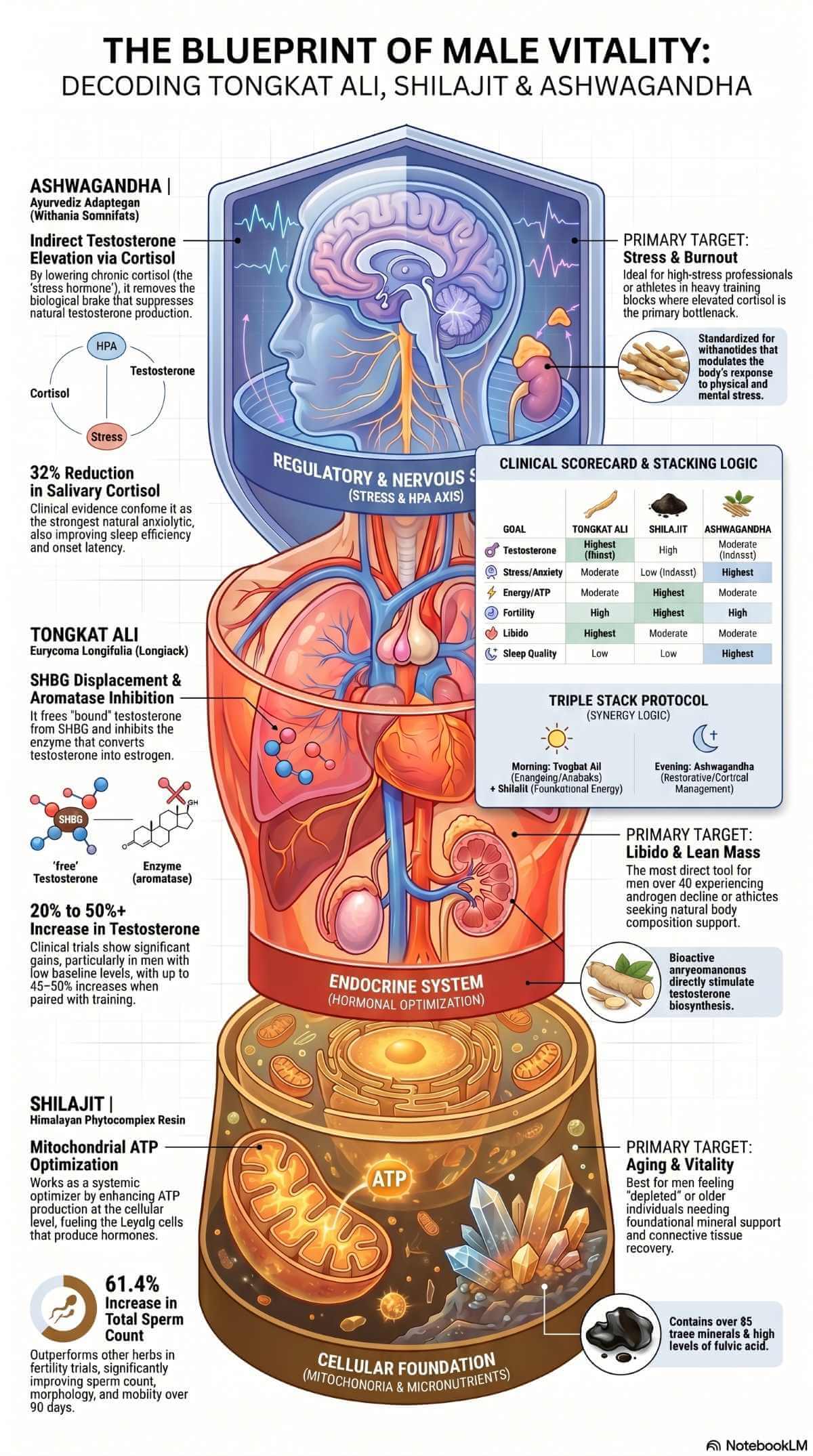
KEY INSIGHT
Tongkat Ali works by directly stimulating testosterone biosynthesis and freeing bound testosterone from SHBG. Ashwagandha works by lowering cortisol, which allows testosterone to rise indirectly. Shilajit works by supplying minerals and fulvic acid to optimize mitochondrial function and support the entire endocrine system. These are complementary mechanisms, not competing ones.
WHAT IT IS
Tongkat Ali (also known as Longjack or Malaysian Ginseng) comes from the root of Eurycoma longifolia, a slender rainforest tree native to Malaysia, Indonesia, and Vietnam. For centuries it has been used as a tonic for male vitality, energy, and sexual function. Today, standardized hot-water extracts — most notably LJ100® — are the forms studied in clinical research.1
HOW IT WORKS
Tongkat Ali contains bioactive compounds called eurycomanones and eurypeptides. These operate through two primary testosterone-elevating mechanisms:2
It also reduces cortisol and activates the CYP-17 enzyme pathway involved in DHEA and testosterone synthesis.3
WHAT THE RESEARCH SHOWS
Of the three herbs, Tongkat Ali has one of the broadest human clinical research profiles for testosterone. A systematic review of five trials found significant improvements in total testosterone at doses of 100–600 mg/day over periods as short as three days and as long as six months.4 Men with low baseline testosterone showed the most pronounced gains — in one six-month study, men with confirmed low testosterone who supplemented with Tongkat Ali saw increases of approximately 43%, with concurrent resistance training pushing that closer to 50%.5
In men with moderate stress, four weeks of 200 mg/day of standardized Tongkat Ali extract reduced salivary cortisol by 16% and increased testosterone by 37%, alongside significant improvements in mood, tension, and anger scores.6
For libido, a 12-week trial at 300 mg/day found an 11–14% improvement in subjective sexual libido scores, along with reduced abdominal fat in overweight participants.7
IMPORTANT SAFETY NOTE
Benefits are most pronounced in men with low testosterone. Men with already-normal levels may see more modest effects. The European Food Safety Authority has flagged a theoretical DNA damage risk at very high doses; stick to established dosing ranges. One documented case of acute liver injury exists at high doses — monitor liver enzymes if using long-term at ≥600 mg/day.
TONGKAT ALI IS BEST FOR
WHAT IT IS
Shilajit is a dark, tar-like resinous substance that seeps from sedimentary rocks in the Himalayas, Altai, and other mountain ranges. Its primary bioactive components include fulvic acid (≥50% in standardized extracts), dibenzo-α-pyrones (DBPs), and over 85 trace minerals.9 In Ayurvedic medicine it is known as a rasayana — a rejuvenating tonic.
HOW IT WORKS
Shilajit does not directly trigger testosterone synthesis the way Tongkat Ali does. Instead, it operates as a systemic optimizer:10
WHAT THE RESEARCH SHOWS
The most cited clinical study is a double-blind, randomized, placebo-controlled trial published in Andrologia. Healthy men aged 45–55 received 250 mg of purified Shilajit (PrimaVie®) twice daily for 90 consecutive days. Results showed significantly increased total testosterone, free testosterone, and DHEA compared to placebo, while LH and FSH were well-maintained.11
A subsequent study using 500 mg/day for 90 days found increases in total testosterone of approximately 20.5%, free testosterone of 19.1%, and DHEA of 31.4%.12 A 2024 RCT using MEET Shilajeet® (500 mg/day) corroborated these findings with statistically significant elevations in both total and free testosterone alongside improvements in vitality and well-being.13
For athletic performance, an eight-week trial at 500 mg/day demonstrated that Shilajit helped retain maximal muscular strength following a fatiguing protocol and reduced serum hydroxyproline — a biomarker of connective tissue breakdown — suggesting protection of tendons and ligaments.14
For male fertility, Shilajit produced some of its most impressive results: a 90-day trial showed a 61.4% increase in total sperm count, an 18.9% increase in normally formed sperm, and improvements in sperm motility of 12–17%.15
KEY DISTINCTION
Shilajit’s testosterone effects are largely about restoring foundational biology. It is particularly effective in older men, those with mineral deficiencies, high-stress individuals, and anyone whose cellular energy machinery has been depleted. It is less likely to produce dramatic testosterone spikes in already-healthy young men.
SHILAJIT IS BEST FOR
WHAT IT IS
Ashwagandha (Withania somnifera) is a small shrub native to India and North Africa whose roots have been used in Ayurvedic medicine for over 3,000 years. Modern extracts standardized for withanolides content — including KSM-66® and Sensoril® — have been used in the majority of clinical trials.17
HOW IT WORKS
Unlike Tongkat Ali and Shilajit, Ashwagandha raises testosterone indirectly, primarily through its action on the stress-response axis:18
WHAT THE RESEARCH SHOWS
A study using a 10:1 extract found cortisol reductions of 32% and testosterone increases of 15.3%.19 A separate trial in 57 healthy men aged 18–64 showed an 18.7% average increase in testosterone over 8 weeks, with measurable gains in muscle recovery and fat loss compared to placebo.20
Where Ashwagandha clearly outperforms both Tongkat Ali and Shilajit is in stress and anxiety reduction. Multiple systematic reviews confirm it as the most evidence-backed natural anxiolytic, with the optimal dose at 600 mg/day for at least 8 weeks.21
It also shows meaningful results for sleep quality — particularly sleep onset latency and sleep efficiency — which has enormous downstream benefits for testosterone, as the bulk of testosterone synthesis occurs during deep sleep.22
For athletes, Ashwagandha has been shown to increase VO₂ max, improve muscle strength, and accelerate recovery, particularly in men with high training stress.23
SAFETY NOTE
Ashwagandha’s steroidal lactones (withanolides) can have a mild sedative effect. Best taken in the evening. Long-term high-dose use (>600 mg/day for extended periods) has been linked in rare cases to liver stress and, anecdotally, emotional blunting. Cycle off every 2–3 months as a precaution.
ASHWAGANDHA IS BEST FOR
BOTTOM LINE
Tongkat Ali has the strongest and most direct evidence for testosterone elevation, particularly in men with low or declining testosterone. Multiple systematic reviews place it at the top alongside Ashwagandha — above Shilajit — for raw testosterone-boosting data. However, the mechanisms are different enough that the right choice depends more on why your testosterone is low than on which herb raises it most.
| Factor | Tongkat Ali | Shilajit | Ashwagandha |
| Primary mechanism | SHBG release + aromatase inhibition | Mitochondrial / HPG axis support | Cortisol reduction (indirect) |
| Typical T increase | 20–50%+ (varies by baseline) | 19–31% | 15–18% |
| Free testosterone | ✔ Strong evidence | ✔ Strong evidence | ~ Some evidence |
| Best in whom | Low T, stressed, aging men | Aging men, depleted, high activity | Chronically stressed individuals |
| Libido impact | ✔ Strong evidence | ~ Some evidence (via T and energy) | ~ Some evidence (via stress reduction) |
| Sperm quality | ✔ Strong evidence | ✔ Strong evidence | ✔ Strong evidence |
| Effect on cortisol | ~ Some evidence (moderate) | ~ Indirect | ✔ Strong evidence (primary mechanism) |
| RCTs on testosterone | 5+ RCTs | 3–4 RCTs | 4+ RCTs |
A 2021 systematic review published in Endocrines analyzed 15 common testosterone-boosting supplement ingredients and concluded that Tongkat Ali, Ashwagandha, and fenugreek had the strongest evidence for increasing testosterone, while Shilajit’s positive effect was shown in fewer studies — though those that exist are robust and well-designed.25
Key takeaway: if you have one goal — raise testosterone — Tongkat Ali is the most targeted and direct tool. If your testosterone is low because you are chronically stressed and sleep-deprived, Ashwagandha may provide a greater net benefit by addressing the root cause. If you are older and feel generally depleted, Shilajit’s mineral-matrix and mitochondrial support may be the missing piece.
| Herb | Domain | Evidence Rating | Notes |
| Tongkat Ali | Testosterone | High (5+ RCTs) | Most direct testosterone data |
| Tongkat Ali | Libido / ED | Strong | Effective for mild-moderate cases |
| Tongkat Ali | Athletic performance | Good | Lean mass, strength, cortisol |
| Tongkat Ali | Stress / mood | Moderate | Secondary to testosterone action |
| Shilajit | Testosterone | Good (3–4 RCTs) | Strong individual trials |
| Shilajit | Energy / ATP | Strong | Mitochondrial mechanism solid |
| Shilajit | Fertility | Strong | Best of three for sperm parameters |
| Shilajit | Cognition | Emerging | Fulvic acid, tau inhibition |
| Ashwagandha | Stress / anxiety | Highest (10+ RCTs) | Most studied natural anxiolytic |
| Ashwagandha | Sleep quality | Strong | Onset latency + efficiency |
| Ashwagandha | Testosterone | Good (4+ RCTs) | Indirect via cortisol |
| Ashwagandha | Athletic performance | Good | VO₂ max, strength, recovery |
Overall, Ashwagandha has the most studies and the widest domain coverage, though Tongkat Ali leads specifically in testosterone and libido outcomes. Shilajit is the least-studied of the three but features some of the most impressively designed individual trials, particularly for fertility and free testosterone in aging men.
Here is how to best use Tongkat Ali, Shilajit and/or Ashwagandha for specific goals, based on clinical dosing data and mechanistic rationale.
Protocol 01 — Testosterone Support (Primary Goal)
| Parameter | Details |
| Best Herb | Tongkat Ali (first choice) + Shilajit (foundational) |
| Dose | Tongkat Ali: 200–400 mg/day standardized extract (e.g. LJ100® or 200:1 extract). Shilajit: 250–500 mg/day purified extract. |
| Timing | Tongkat Ali: morning, with or without food. Shilajit: with meals (improves absorption). |
| Duration | Minimum 6–12 weeks for measurable results. Can be used daily long-term at lower doses (200 mg TA). |
| Notes | Test baseline testosterone before starting. Greatest gains in men with low-normal T (<500 ng/dL). Add resistance training for synergistic effect. |
Protocol 02 — Libido & Sexual Health
Parameter | Details |
| Best Herb | Tongkat Ali (primary) — if stress is a driver, add Ashwagandha |
| Dose | Tongkat Ali: 200–400 mg/day. If adding Ashwagandha: 300–600 mg/day (evening). |
| Timing | Tongkat Ali: morning (stimulating). Ashwagandha: 30–60 minutes before sleep. |
| Duration | Libido improvements typically noticed within 3–6 weeks. Erectile function improvement: 8–12 weeks for mild-to-moderate cases. |
| Notes | Tongkat Ali evidence shows benefit primarily in mild-to-moderate erectile dysfunction. Severe cases warrant medical evaluation. |
Protocol 03 — Sports Performance & Body Composition
| Parameter | Details |
| Best Herb | Tongkat Ali (lean mass, free T) + Shilajit (energy, connective tissue) |
| Dose | Tongkat Ali: 400 mg/day. Shilajit: 500 mg/day. Add Ashwagandha (300 mg AM) during heavy training blocks. |
| Timing | Both Tongkat Ali and Shilajit in the morning or pre-workout. Ashwagandha in the evening. |
| Duration | 4–6 week minimum; best results at 8–12 weeks of consistent training and supplementation. |
| Notes | Athletes subject to anti-doping: Tongkat Ali does not typically cause a failed drug test, but choose Informed Sport-certified products. Shilajit at 500 mg/day showed strength retention and reduced connective tissue breakdown. |
Protocol 04 — Aging Men (40+) & Vitality
| Parameter | Details |
| Best Herb | Shilajit (foundational) + Tongkat Ali (hormonal) + Ashwagandha (stress + sleep) — this use case justifies the full triple stack. |
| Dose | Shilajit: 250–500 mg/day. Tongkat Ali: 200–400 mg/day. Ashwagandha: 300–600 mg/day (evening). |
| Timing | Shilajit + Tongkat Ali: morning with breakfast. Ashwagandha: before bed. |
| Duration | Ongoing, with a 1-week break every 2–3 months for Ashwagandha. Tongkat Ali and Shilajit can be taken continuously. |
| Notes | Get baseline bloodwork (T, free T, SHBG, cortisol) before starting. Greatest gains at this age from combining hormone optimization, cellular energy, and stress/sleep management. |
Protocol 05 — Stress, Burnout & Sleep
| Parameter | Details |
| Best Herb | Ashwagandha (primary) + Shilajit (energy restoration) |
| Dose | Ashwagandha: 600 mg/day (KSM-66® or equivalent). Shilajit: 250 mg/day. |
| Timing | Ashwagandha: evening meal or 1 hour before bed. Shilajit: morning. |
| Duration | 8–12 weeks minimum for anxiety/stress outcomes. Sleep benefits often apparent within 2–4 weeks. |
| Notes | Do NOT use Tongkat Ali as your primary herb if burnout and fatigue are the core issues — its stimulating properties can worsen anxiety in sensitive individuals. |
Protocol 06 — Male Fertility
| Parameter | Details |
| Best Herb | Shilajit (sperm count/morphology) + Ashwagandha (motility/LH/FSH) + Tongkat Ali (concentration) |
| Dose | Shilajit: 500 mg/day. Ashwagandha: 600 mg/day. Tongkat Ali: 200 mg/day. |
| Timing | Shilajit + Tongkat Ali: morning. Ashwagandha: evening. |
| Duration | Sperm maturation cycle is ~74 days — evaluate results at 90 days minimum. |
| Notes | All three herbs have individual clinical evidence for male fertility parameters. The combination addresses count, motility, morphology, and the hormonal signaling (LH/FSH) that drives spermatogenesis. |
The short answer is yes, but only in moderate doses and in short duration. Although the combined effects of these herbs are not clinically tested on humans, experts believe the combination is often more powerful than any single herb alone, precisely because the mechanisms are complementary, not redundant.
| Stack | Best For | Synergy Logic |
| Tongkat Ali + Shilajit | Athletes, hormone optimization | TA raises free T via SHBG; Shilajit provides cellular energy for T synthesis + connective tissue protection |
| Tongkat Ali + Ashwagandha | Libido + stress management | TA stimulates T directly; Ashwagandha reduces cortisol suppression of T. Day/night protocol works well. |
| Ashwagandha + Shilajit | Burnout recovery, sleep, energy | Cortisol control (Ashwagandha) + mitochondrial fuel (Shilajit). Ideal for depleted, over-stressed individuals. |
| All three (triple stack) | Aging men 40+, comprehensive vitality | Covers all three pathways: direct T stimulation, cellular energy/mineral support, cortisol management + sleep |
STACKING TIMING TIP
When combining all three, use a morning/evening split: take Tongkat Ali and Shilajit in the morning (energizing and anabolic) and Ashwagandha in the evening (calming and restorative). This prevents any overlap in stimulatory or sedative effects and respects the natural circadian rhythm of cortisol and testosterone.
WHAT NOT TO STACK
Avoid combining high-dose Tongkat Ali (≥600 mg) with other substances that increase testosterone dramatically (e.g. DHEA, Fadogia agrestis) without medical supervision. Avoid high-dose Ashwagandha (>600 mg/day) for extended periods without cycling off, and do not use it with other GABAergic sedatives without guidance from a healthcare provider.
Tongkat Ali, Shilajit, and Ashwagandha are not interchangeable — they represent three genuinely different tools targeting different biological levers. Understanding what each does at a mechanistic level transforms this from a confusing comparison into a clear, goal-driven decision.
If you leave this guide with one insight, let it be this: the herb that will benefit you most is the one that addresses your primary bottleneck. If your testosterone is low because your cortisol is chronically elevated and you can’t sleep, Ashwagandha will do more for you than Tongkat Ali. If you’re depleted, aging, and feel like your cellular engine is running on fumes, Shilajit’s mineral and mitochondrial support may be the missing piece. If you have confirmed low testosterone and want the most direct natural tool to address it, Tongkat Ali is your first port of call.
The good news is that you don’t have to choose just one. The triple stack is well-tolerated, mechanistically elegant, and represents what much of the men’s health field considers a comprehensive natural approach to hormonal optimization. Start with one, observe your response, and build from there. Always verify quality — choose standardized, purified extracts (AKARALI Physta® or 200:1 for Tongkat Ali, PrimaVie® or MEET Shilajeet® for Shilajit, KSM-66® or Sensoril® for Ashwagandha), and get baseline bloodwork before and after.
Natural supplementation is a support strategy, not a replacement for sleep, resistance training, healthy body composition, and stress management — which remain the most powerful evidence-based levers of testosterone optimization of all.
QUICK REFERENCE SUMMARY
Best for testosterone: Tongkat Ali (direct) / Ashwagandha (via cortisol reduction) Best for energy & aging: Shilajit Best for stress & sleep: Ashwagandha Best for libido: Tongkat Ali Best for fertility: Shilajit (count/morphology) + Ashwagandha (motility) Best for athletes: Tongkat Ali + Shilajit Best for men 40+: All three (triple stack)
This article is for informational purposes only and does not constitute medical advice. Always consult a qualified healthcare provider before starting any supplementation protocol, particularly if you have underlying health conditions or take prescription medications.

Alex Kua leads AKARALI’s Global Partnership Community to help athletes, sports communities, and thousand of others optimize their well-being through evidence-based research that enables them to make better informed decisions. His legal and business consulting background underpins the rigorous data-driven approach in his writing – from hours of interviews, real-world performance data, and firsthand experiences of real people – offering actionable insights that connects clinical research, emerging health trends, and real-world applications. He is also an experienced researcher in herbal nutrition, with years of deep technical knowledge on Tongkat Ali (Eurycoma longifolia), including quality standards, industry benchmarks, lab tests, clinical trials, and the use of natural herbs by collaborating with top scientists, herbal experts, and nutritionists. As part of the core team behind AKARALI’s knowledge portal, he empowers people worldwide to access the benefits of high-quality herbal nutrition in a way that is effective, sustainable, and safe. He is also an avid runner, with regular participation in local sports communities and running events.
Disclaimer:
The content published on this website is for educational purposes and should not be viewed, read, or seen as a prescription or constitute any form of medical advice. We recommend you consult your nearest GP or doctors before consuming Tongkat Ali or any products which contain Tongkat Ali. For further information, kindly refer to our Frequently Asked Questions (FAQ) for more information.