

Anyone who has spent time with stimulants — caffeine, pre-workouts, the occasional energy drink binge — knows the familiar arc. The first dose is a revelation. A few weeks in, the same amount barely registers. You climb the dose, chase the old feeling, and eventually accept a new, muted normal. It is one of the most reliable patterns in supplementation, and it is the reason so many people ask a sensible question before committing to any daily botanical: will this stop working for me?
With Tongkat Ali (Eurycoma longifolia), and specifically with the standardised Physta® extract AKARALI is built on, the honest answer is more encouraging than most expect — but it deserves a proper explanation rather than a marketing slogan. Tolerance is not a mystical property of “strong” supplements; it is a specific biological process with specific causes. Once you understand what actually drives it, it becomes clear why Tongkat Ali sits in a different category, and why the people who benefit most are often those who have taken it the longest.
A note on framing before we go further. Physta® is a food supplement, not a medicine. Nothing here is intended to diagnose, treat, cure or prevent any disease. What the science can speak to is nutritional and hormonal support — how a standardised extract may support the body’s own testosterone balance, stress response and everyday energy over time. That is the honest lens for this discussion, and it is also, conveniently, where Tongkat Ali’s real strengths lie.
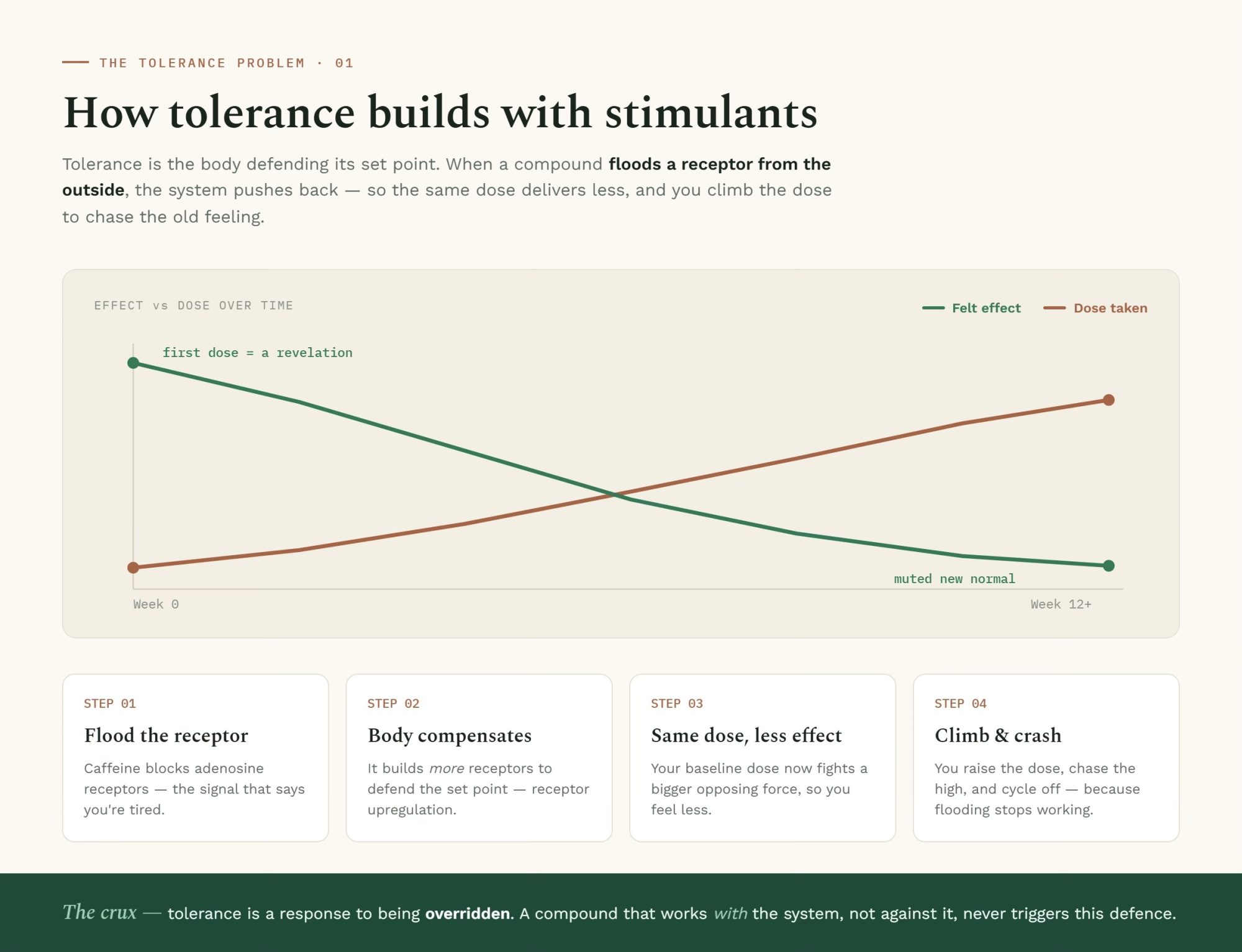
Pharmacological tolerance is the body adapting to a repeated input until the same dose produces a smaller effect. It has a few classic mechanisms, and stimulants tend to hit all of them. Caffeine is the textbook case: it works by blocking adenosine receptors, the molecular signal that tells you you’re tired. Do that every day and the body simply builds more adenosine receptors to compensate. Within weeks, your baseline dose is fighting a bigger opposing force, so you feel less, and you need more to break even.
The same broad pattern shows up wherever a compound floods a receptor or forces a spike in neurotransmitters. The system is designed to defend its set point. Push it hard from the outside and it pushes back — downregulating receptors, blunting the response, and setting up the crash and rebound that follow the high. This is why cycling exists in stimulant culture: you take breaks precisely because continuous flooding stops working.
Hold onto that phrase — flooding a receptor from the outside — because it is the crux of the whole question. Tolerance is fundamentally a response to being overridden. A compound that does not override the system, but instead works with it, does not trigger the same defensive adaptation.
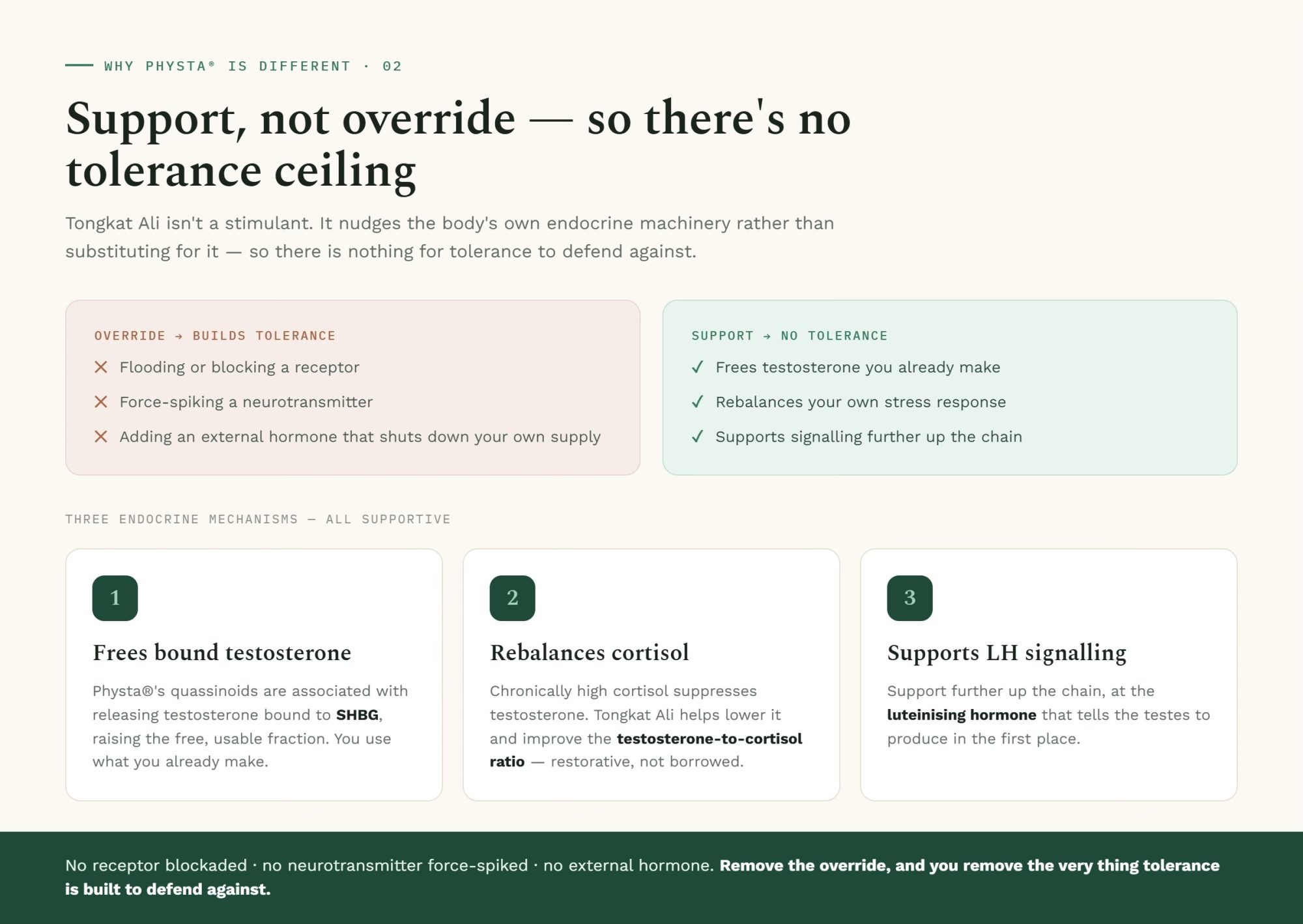
Tongkat Ali is not a stimulant, and it does not work by flooding a receptor. It is best understood as an endocrine and stress-axis modulator — it nudges the body’s own machinery rather than substituting for it. Three mechanisms matter here, and none of them is the kind of override that drives tolerance.
First, it appears to support the release of testosterone that is already present but bound up. A large share of circulating testosterone is stuck to a carrier protein called SHBG (sex hormone-binding globulin) and is biologically inactive. Physta®’s quassinoids — the bitter compounds standardised in the extract — are associated with freeing more of that bound testosterone, raising the free, usable fraction. You are not adding an external hormone; you are helping the body use what it already makes.
Second, it supports a healthier stress response. Chronically elevated cortisol suppresses testosterone, and Tongkat Ali has been shown to help lower cortisol and improve the testosterone-to-cortisol ratio — a genuinely restorative effect rather than a borrowed one. Third, there is signalling support further up the chain, at the level of the luteinising hormone that tells the testes to produce in the first place.
The common thread is that Physta® supports endogenous production and hormone availability. There is no receptor being blockaded, no neurotransmitter being force-spiked, no external hormone shutting down your own supply through negative feedback. Remove that override, and you remove the very thing tolerance is built to defend against. Mechanistically, there is simply no tolerance ceiling to run into.
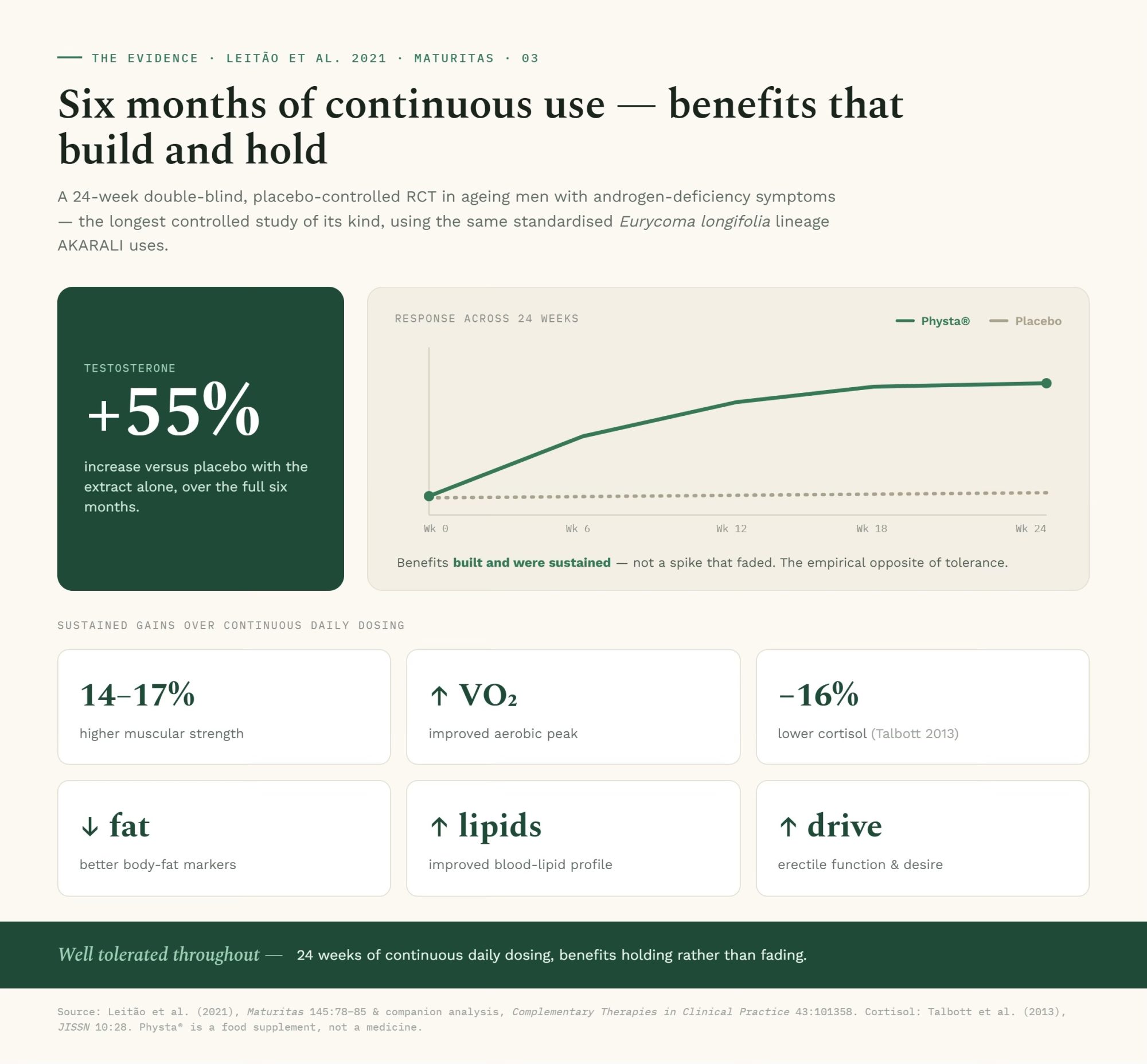
Mechanism is reassuring, but the more important question is whether continuous use holds up in practice — and here Physta® is unusually well studied for a botanical. The standout is a six-month randomised controlled trial (Leitão et al., 2021, published in Maturitas), the longest controlled study of its kind. Men with symptoms of androgen deficiency took a standardised Eurycoma longifolia extract (the same extract AKARALI uses) continuously for 24 weeks. Testosterone rose substantially — on the order of a 55% increase versus placebo with the extract alone — alongside improvements in erectile function and sexual desire, and the extract was well tolerated throughout.
The critical detail for this discussion is the shape of the response over time. Benefits did not appear, peak in week two, and then fade as the body adapted. They built and were sustained across the full six months of continuous daily dosing. That is the empirical opposite of tolerance. A companion analysis reported alongside the trial found continued gains in physical performance — muscular strength up in the region of 14–17%, improvements in VO₂ peak, and better body-fat and blood-lipid markers — again over sustained use, not a fading novelty effect.
This fits the broader Physta® evidence base. Talbott and colleagues (2013) documented meaningful reductions in cortisol (around 16%) and improved mood — tension, anger and confusion all down — over four weeks of continuous supplementation in both men and women. Work in older adults (Henkel et al., 2014) showed hormonal and muscular benefits with daily use, and Chinnappan and colleagues (2021) reported quality-of-life improvements in ageing populations. Across these studies, the pattern is consistent: continuous dosing produces effects that accumulate and hold, rather than diminishing returns that force you to keep climbing the dose.
It helps to put that six-month trial in context. Most proprietary standardised botanicals studied for testosterone, vitality and healthy ageing are tested in relatively short windows — commonly eight to twelve weeks. Fenugreek extracts such as Testofen have typically been trialled over six to twelve weeks; maca studies usually run eight to twelve weeks; and the most-studied ashwagandha brand, KSM-66, has published its efficacy trials mostly in the eight-to-twelve-week range. Only a handful of trials in the wider field stretch to around eighteen weeks. Against that backdrop, a continuous 24-week (six-month) placebo-controlled study is unusually long for this category.
Two honest caveats keep this in proportion. Longer does not automatically mean better — a well-designed twelve-week trial can be more informative than a longer, weaker one — and a few botanicals have been studied for longer in unrelated medical settings, such as standardised Panax ginseng, which has been trialled for around six months in respiratory conditions. So the fair claim is not that Physta® holds some absolute record. It is that within the testosterone and healthy-ageing space specifically, being studied continuously for six months — with benefits that were sustained and improving rather than fading — sits at the longer end of what has actually been done.
One practical consequence of all this is that Physta® does not demand dose escalation to keep working. The everyday evidenced range sits comfortably at 200–400 mg per day, and that range keeps delivering on continuous use rather than needing to be nudged upward month after month. Controlled trials that used more — up to 600 mg per day in men aged 35–58 (Tambi, 2005), and 600 mg per day in younger men (Chan et al., 2021, which reported total testosterone up around 15% and free testosterone up around 34%) — confirmed the extract stays safe and effective at the upper end, but they did not establish 600 mg as a routine requirement. The takeaway is not “take more over time.” It is that a steady, sensible daily dose is designed to keep pulling its weight.
This is the difference between working with your body and spiking it. Physta® supports SHBG balance, free and total testosterone, and a calmer cortisol response — tuning the system progressively and continuously. It does not flood you with external hormones, force a short-lived neurotransmitter high, or deliver a lift that fades the way rhodiola or ginseng sometimes can without cycling. With your own system, there is no shutdown and no crash to recover from; against your system, there is a boost, then tolerance, then rebound.
Put the trials and the customer reports side by side and a clear timeline emerges. Within the first few weeks of consistent use, most people notice something — steadier energy, better training recovery, a lift in drive and mood. The effect tends to reach its fullest expression around week eight to twelve, which lines up neatly with the arc seen in the controlled research. From there it does not fall off; it builds modestly and settles, holding over months and, for long-term users, years.
There is an intuitive way to think about why the effect can seem to deepen rather than dull. Physta® supports the raw materials of performance — available testosterone, a balanced stress response, recovery capacity. The more you ask of your body — harder training, longer runs, heavier lifts — the more those supported systems have to work with, and the more the support shows up in results. Far from blunting, the benefit often becomes more relevant as demands rise.

There is a final twist that sets Tongkat Ali apart from most supplements, where the story is usually one of diminishing returns. With Physta®, the people who tend to see the most pronounced benefit are often the ones who have the most room to move: ageing men. As the years pass, SHBG rises and free testosterone falls, metabolism slows, muscle gets harder to build, and fatigue hits harder. Those are precisely the levers Physta® supports.
It is no coincidence that the six-month trial and the older-adult studies — the research most relevant to men managing age-related decline — are where some of the clearest benefits show up. For a long-term user, this reframes the whole tolerance worry. The concern was “will it stop working as I keep taking it?” The more accurate expectation, supported by both the biology and the trials, is that continued use meets a body whose needs are gradually growing — so the support stays relevant, and often becomes more so, over the years.

“I can speak to this personally. I have taken AKARALI Physta® continuously at a steady dose of 400 mg for more than three years, without cycling off, and the honest report is unremarkable in the best possible way: no noticeable fade in effect, no need to keep raising the dose, no side effects that made me want to stop. The steadier energy and recovery that first showed up in the early weeks are still there years later — quietly load-bearing rather than dramatic. If Physta® behaved like a stimulant, three years of daily use would have flattened the effect long ago. It hasn't and seems to be progressively working better than when I started - the effect feels more potent at 36 than when I first started at 33.”
That experience is not unique to me, which speaks to the point. Across the AKARALI community and on our TrustPilot reviews, some of the most enthusiastic customers are the multi-year ones — people who reordered not because a novelty thrilled them, but because a baseline improved and stayed improved. From men in their late 20s to those in their 60s who have never taken anything more complicated than the occasional paracetamol — their common refrain is consistency: the same steady benefit, held over a long horizon. Individual results always vary, of course, and no supplement is a guarantee, but the pattern in the anecdotes from multiple customers mirrors the pattern in the clinical trials rather than contradicting it.
The clearest way to see why Tongkat Ali is different is to line it up against the popular supplements people are routinely told to cycle. In almost every case, the reason for cycling comes back to the same root cause we identified earlier: the compound overrides the body in some way — flooding a receptor, forcing a neurotransmitter spike, or adding an external hormone that switches off your own production. Physta® does none of these. It’s worth being honest that the strength of the cycling case varies: for stimulants and hormones it’s mechanistically clear-cut, while for adaptogens like ashwagandha and rhodiola it’s largely a precaution rather than a proven necessity.
| Supplement | Why people cycle it | How solid is the cycling case? |
| Caffeine / pre-workout | Blocks adenosine receptors; daily use makes the body build more of them, so the same dose does less. | Strong. Genuine, well-documented tolerance — breaks or deloads restore sensitivity. |
| Yohimbine | Blocks alpha-2 adrenergic receptors, which adapt with repeated daily exposure. | Moderate to strong. Receptor tolerance is real; commonly cycled to stay responsive. |
| Ashwagandha | Withanolides may downregulate receptors; the cortisol effect is often strongest in the first weeks. | Precautionary. Widely cycled by habit, but clinical evidence for true tolerance is limited. |
| Rhodiola rosea | Adaptogenic lift can feel like it plateaus with continuous use. | Weak / precautionary. No strong evidence of tolerance; cycling is optional habit. |
| Melatonin | A signalling hormone; higher continuous doses raise dependence and next-day grogginess concerns. | Context-dependent. Often used short-term rather than indefinitely. |
| DHEA / prohormones / SARMs / TRT | Add an external hormone, which triggers negative feedback and suppresses your own production. | Strong. Cycling, breaks or post-cycle support are needed to recover natural output. |
| Physta® Tongkat Ali | Supports your own testosterone availability (SHBG), free and total testosterone and cortisol balance — no receptor flooding, no external hormone. | No tolerance ceiling. Continuous use studied to six months; cycling optional. |
Read down the table and the divide is obvious. Everything that genuinely needs cycling shares a mechanism of override — and the two categories with the strongest cycling case, stimulants and exogenous hormones, are the ones that override the body most forcefully. Tongkat Ali sits in the opposite corner: it is non-stimulant, adds no external hormone, and supports rather than replaces your own endocrine output. That single structural difference is why the cycling logic that applies to the rest of the list simply doesn’t apply to Physta® in the same way.
Cycling — taking scheduled breaks — is a sensible precaution for compounds that build tolerance or suppress your own production, which is exactly why it became standard advice in stimulant and hormone circles. Tongkat Ali is neither. It is non-stimulant, it works by supporting the body’s own endocrine output rather than replacing it or “boosting” it, and the longest controlled trial ran continuously for six months with sustained benefit, good tolerability and no safety issues.
So cycling Physta® is best treated as optional rather than required. Some people still prefer to take an occasional break for their own reasons, and that is perfectly fine — there is no evidence it causes harm or diminishes the benefits. But the idea that you must cycle to keep it working is a holdover from a different class of compounds, and it does not map onto how Tongkat Ali actually behaves. Continuous daily use is a legitimate, evidence-consistent way to use it.
Practically, getting the most from continuous use is simple. Take a standardised extract at a consistent daily dose in the evidenced 200–400 mg range, ideally at the same time each day — many people prefer the morning with food for general use or approximately 30 minutes before exercise for performance. Give it a proper runway: judge it over eight to twelve weeks rather than a few days, since the fullest effect builds over that window. Then simply keep going. There is no requirement to escalate the dose and no requirement to schedule breaks. That said, the one lever worth pushing is effort. A steadier hormonal and recovery baseline only proves its worth when you actually draw on it — so those who run further, lift heavier or spar longer are usually the ones who notice it most. Ask more of your body and it has more reason to put that steadier foundation to work.
Two honesty notes. First, quality matters more than heroics: a properly standardised extract like Physta®, with a defined quassinoid and eurycomanone content range, is what the clinical evidence is actually based on — unstandardised root powder or generic extracts are not the same thing. Second, continuous use has been formally studied out for up to six months; beyond that, the reassurance comes from a long track record of real-world use rather than a multi-year, controlled trial. Many people, myself included, have used it well past that horizon without issue, but it is fair to distinguish clinical evidence from lived experience. If you take medication or have an underlying health condition, check with a healthcare professional before starting, as you would with any supplement.
Does Tongkat Ali lose its effect if you take it every day?
The available evidence points the other way. Because Physta® works by supporting your body’s own testosterone availability and stress response rather than flooding a receptor, it doesn’t trigger the receptor downregulation that drives stimulant tolerance. In a six-month controlled trial, benefits built and were sustained over 24 weeks of continuous daily use rather than fading.
Do I need to cycle Tongkat Ali?
Cycling is optional, not required. It’s a precaution borrowed from older bodybuilding theories regarding stimulants and exogenous hormones — compounds that build tolerance or suppress your own production. Tongkat Ali does neither. You can take a break if you prefer, but there’s no evidence you need to in order to keep it working.
Will I need to keep increasing the dose over time?
No. The evidenced everyday range of 200–400 mg per day keeps delivering on continuous use without escalation. Trials using up to 600 mg confirmed safety and efficacy at the upper end, but did not establish that you need to climb to that dose to maintain results.
How long does it take to feel the full effect?
Most people notice steadier energy, recovery and drive within the first few weeks, with the fullest effect typically around week 8 to 12 — which matches the arc seen in the clinical research. From there it tends to build modestly and hold rather than fade.
Is it safe to take Tongkat Ali continuously for years?
Continuous use has been formally studied out to six months with good tolerability. Beyond that, reassurance comes from a long real-world track record, including multi-year users, rather than a controlled trial. As with any supplement, if you take medication or have a health condition, check with a healthcare professional. Physta® is a food supplement, not a medicine.
Why do older men often see bigger benefits?
Ageing raises SHBG and lowers free testosterone, slows metabolism and increases fatigue — the exact systems Physta® supports. The men with the most room to move often see the clearest response, which is why the longest trials, run in older men managing age-related decline, show some of the strongest results.
Do I need to cycle Tongkat Ali the way I cycle caffeine or ashwagandha?
No — and the reason is mechanistic. Caffeine builds genuine receptor tolerance, and hormonal products like DHEA or TRT suppress your own production, so both benefit from breaks. Ashwagandha and rhodiola are commonly cycled too, but that’s largely a precaution rather than proven necessity. Tongkat Ali overrides nothing — it supports your own hormone availability and stress balance — so the cycling logic that applies to those supplements doesn’t apply to Physta® in the same way.
Leitão, A. E., et al. (2021). A 6-month, double-blind, placebo-controlled randomised trial of Eurycoma longifolia (Physta®) on androgen deficiency in ageing men. Maturitas, 145, 78–85. https://doi.org/10.1016/j.maturitas.2020.12.002
Leitão, A. E., et al. (2021). Companion analysis: effects of continuous Eurycoma longifolia supplementation on muscular strength, aerobic capacity and metabolic markers. Complementary Therapies in Clinical Practice, 43, 101358. https://doi.org/10.1016/j.ctcp.2021.101358
Chan, K. Q., Stewart, C., et al. (2021). The effect of Eurycoma longifolia on the regulation of reproductive hormones in young males. Andrologia, 53, e14001. https://doi.org/10.1111/and.14001
Talbott, S. M., Talbott, J. A., George, A., & Pugh, M. (2013). Effect of Tongkat Ali (Eurycoma longifolia) on stress hormones and psychological mood state in moderately stressed subjects. Journal of the International Society of Sports Nutrition, 10(1), 28. https://doi.org/10.1186/1550-2783-10-28
Henkel, R. R., et al. (2014). Tongkat Ali as a potential herbal supplement for physically active male and female seniors — a pilot study. Phytotherapy Research, 28(4), 544–550. https://doi.org/10.1002/ptr.5017
Chinnappan, S. M., George, A., et al. (2021). Effect of Eurycoma longifolia standardised aqueous extract (Physta®) on quality of life and hormonal balance. Journal of Herbal Medicine, 28, 100442. https://doi.org/10.1016/j.hermed.2021.100442
Tambi, M. I. B. M. (2005). Standardised water-soluble Eurycoma longifolia (Physta®) at 200–600 mg/day: safety and testosterone outcomes in men aged 35–58, as summarised in AKARALI’s Physta® clinical studies dossier. https://akarali.com/physta-clinical-studies/
George, A., & Henkel, R. (2018). Phytoandrogenic properties of Eurycoma longifolia as natural alternative to testosterone replacement therapy. Andrologia, 46(7), 708–721. https://doi.org/10.1111/and.12214
Biotropics Malaysia. Physta® standardised Eurycoma longifolia extract: clinical evidence summary. https://www.biotropics.com
Smith, S. J., Lopresti, A. L., et al. (2022). Examining the effects of herbs on testosterone concentrations in men: A systematic review. Advances in Nutrition, 13(4), 1245-1259. https://www.sciencedirect.com/science/article/pii/S2161831322001028
AKARALI. Physta® clinical studies. https://akarali.com/physta-clinical-studies/

Alex Kua leads AKARALI’s Global Partnership Community to help athletes, sports communities, and thousand of others optimize their well-being through evidence-based research that enables them to make better informed decisions. His legal and business consulting background underpins the rigorous data-driven approach in his writing – from hours of interviews, real-world performance data, and firsthand experiences of real people – offering actionable insights that connects clinical research, emerging health trends, and real-world applications. He is also an experienced researcher in herbal nutrition, with years of deep technical knowledge on Tongkat Ali (Eurycoma longifolia), including quality standards, industry benchmarks, lab tests, clinical trials, and the use of natural herbs by collaborating with top scientists, herbal experts, and nutritionists. As part of the core team behind AKARALI’s knowledge portal, he empowers people worldwide to access the benefits of high-quality herbal nutrition in a way that is effective, sustainable, and safe. He is also an avid runner, with regular participation in local sports communities and running events.
Disclaimer:
The content published on this website is for educational purposes and should not be viewed, read, or seen as a prescription or constitute any form of medical advice. We recommend you consult your nearest GP or doctors before consuming Tongkat Ali or any products which contain Tongkat Ali. For further information, kindly refer to our Frequently Asked Questions (FAQ) for more information.